In Defense of Ivy
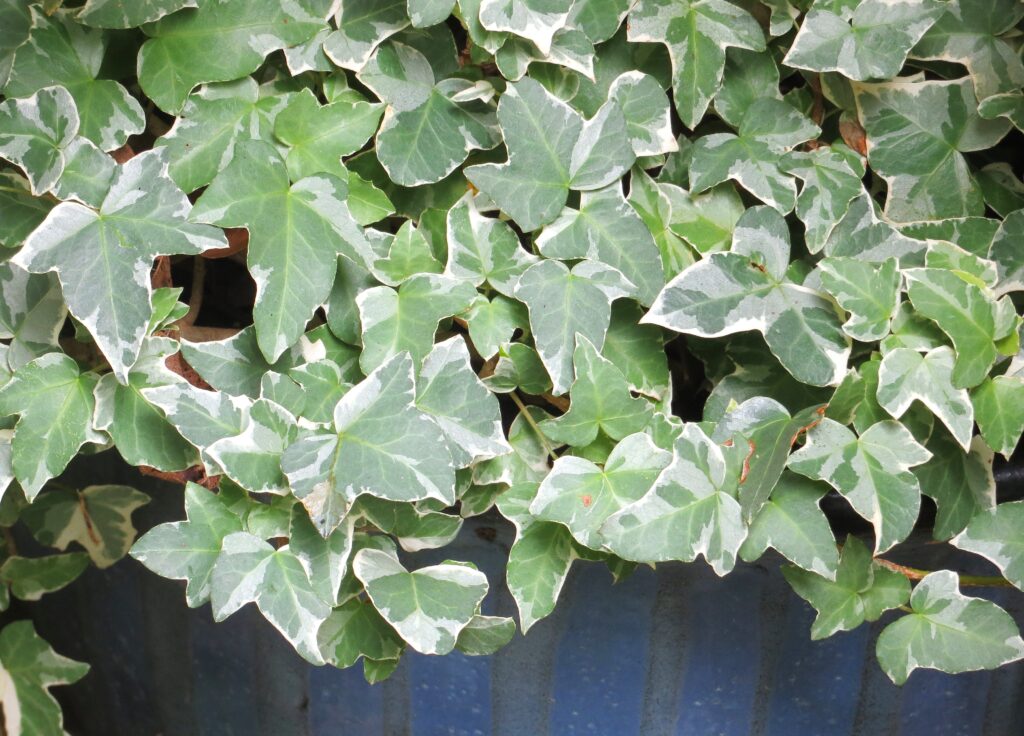
Variegated English ivy, Hedera helix, fills a container in a shady corner near our porch.
Ivy: Hero or Villain?
English ivy, celebrated in hymns and carols, rich in history and tradition, may be among the most hated of ‘imported’ plants for some American gardeners. Native plant enthusiasts may call ivy a ‘noxious weed.’ And now, thanks to a new state law, HB 1941, which will go into effect in Virginia in January of 2027, horticultural retailers will be required to label ivy as an invasive plant and suggest alternatives whenever it is sold directly to consumers. Any business that doesn’t post the information exactly as required by the Commissioner of Agriculture and Consumer Services can be prohibited from selling the plant until it does. Maryland passed a nearly identical bill that has also been signed into law. Native plant enthusiasts have lobbied the state legislature for such a law for many years.
What is Ivy?
Ivy, Hedera helix, is an evergreen woody vine with beautiful, intricately marked, glossy palmate leaves. Though juvenile ivy creeps as a ground cover, it can eventually mature into a shrub when it grows vertically. Native in warmer areas of Europe and parts of Western Asia, ivy is an ancient plant. Fossils of ivy, Hedera leaves, found in Korea, date back to 30 million years ago. The ivy species commonly cultivated today, H. helix, first appeared around 10 million years ago around the Mediterranean Sea. Hedera is a genus within the Araliaceae or ginseng family, and the common H. helix includes more than 30 ornamental cultivars, 16 of which have earned the Royal Horticultural Society’s Award of Garden Merit in the UK.
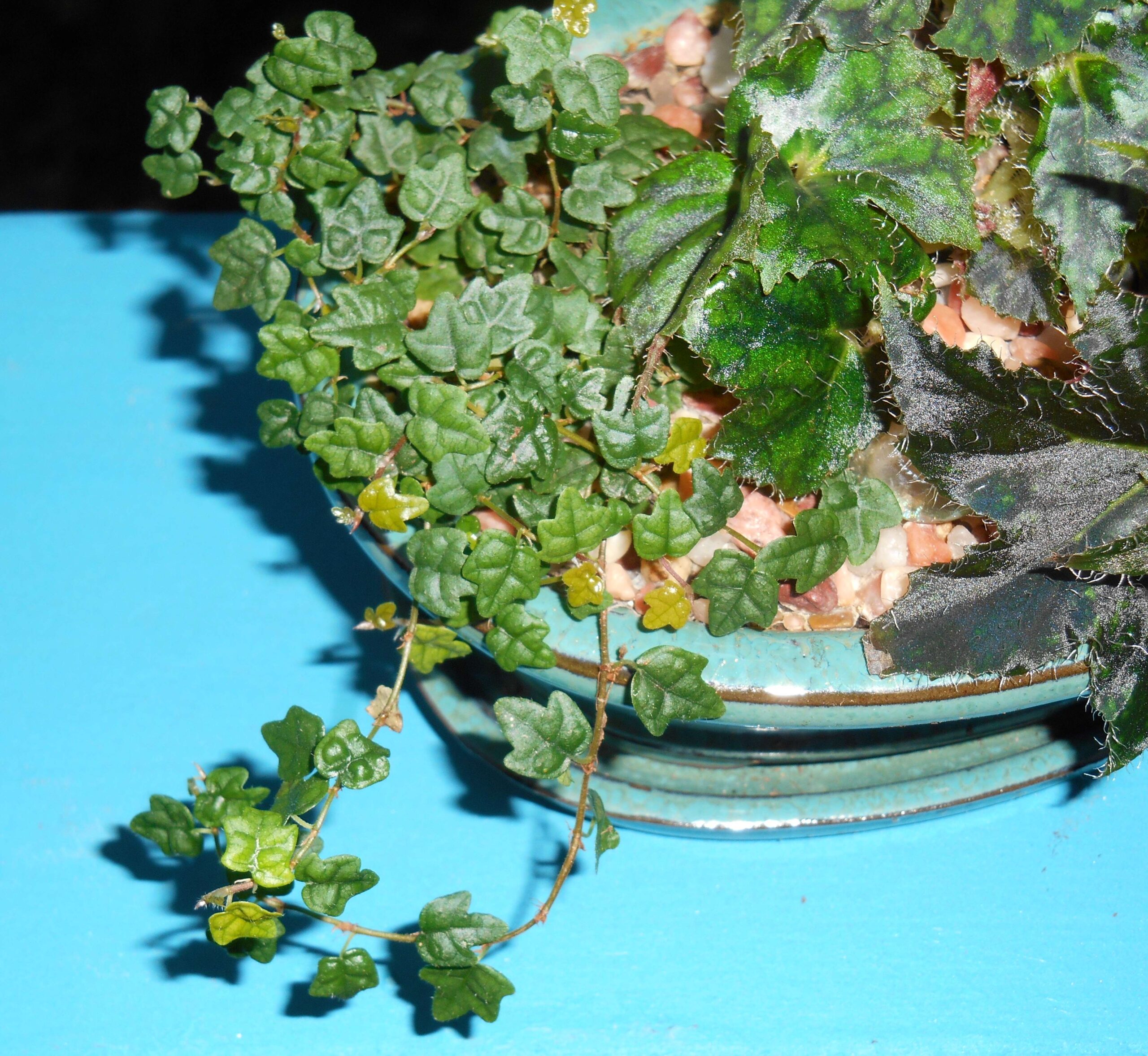
Miniature ivy serves as ground cover in a container arrangement with Begonia.
Growing Ivy Indoors
Little pots or hanging baskets of rooted ivy have been popular houseplants and gifts for as long as I can remember. Ivy is a staple wherever houseplants and garden plants are sold. Grocery and home goods stores often offer pretty varieties of ivy potted in ceramic novelty containers during various holidays. Ivy is a popular houseplant because it is tolerant of spotty care and the sort of less-than-ideal conditions found in many homes, apartments, and dorm rooms. It grows well with little light, low humidity, and the occasional dry spell when someone forgets to water it. But keep ivy out of the reach of pets and small children.
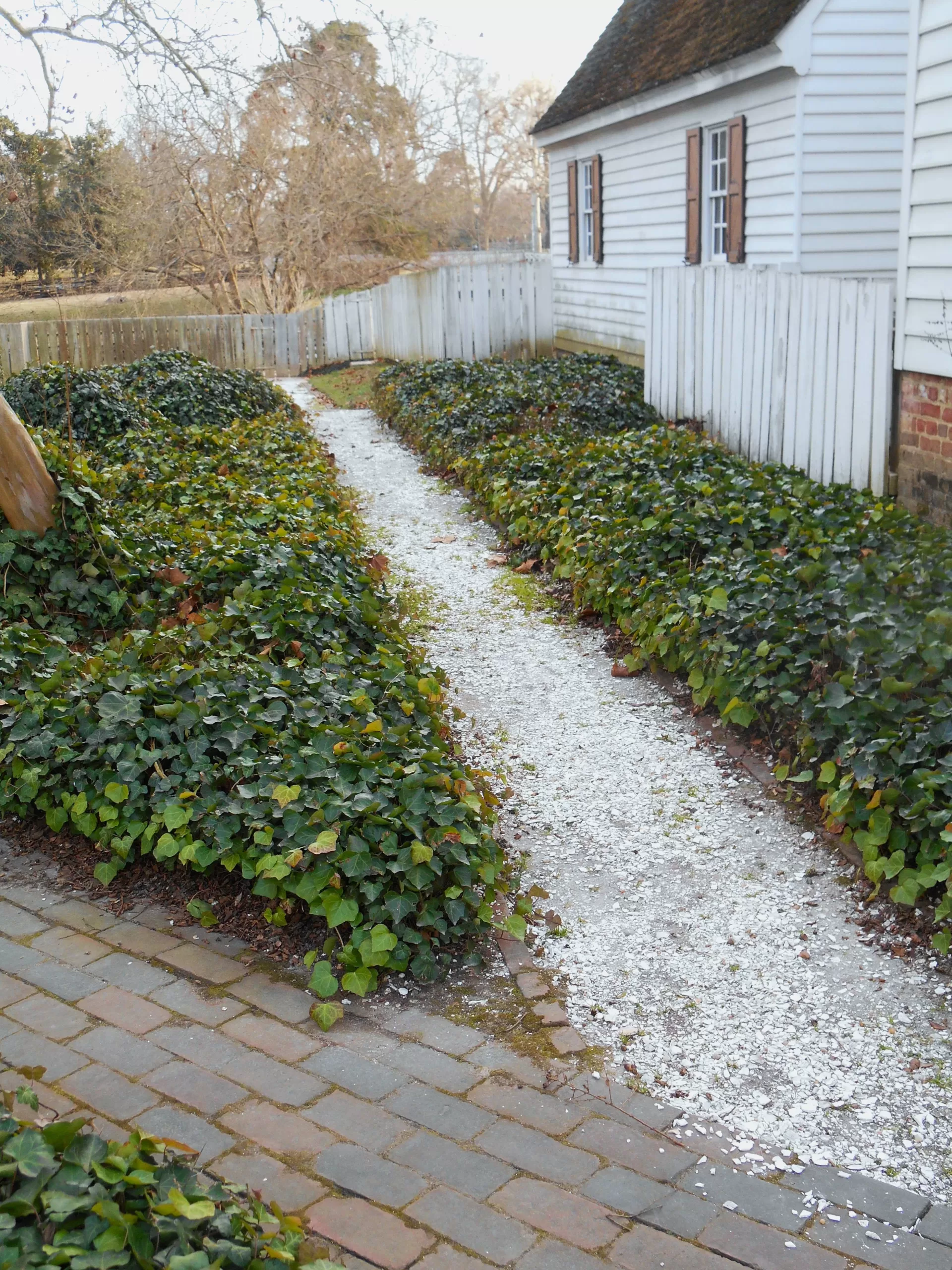
English ivy is a popular ground cover in Colonial Williamsburg. December 2016
Versatile, Resilient Ivy
English ivy thrives in dry shade and will grow in most any sort of soil, including soil that is compacted, thin, chalky, polluted or damaged. Ivy is useful for reclaiming and cleansing polluted soil, for covering eroding soil, and for providing a bit of color through a long, cold winter. It will even grow over stone, masonry, wood, or concrete providing it can sink its major roots into soil somewhere nearby.
The very qualities that make ivy resilient and versatile also earn it scorn. It can out-compete herbaceous plants as it grows over and shades them. Ivy can climb the trunks of trees and grow along the tree’s branches, sometimes shading out leaves growing on the tree and adding weight to the tree’s structure. It can grow to 80’-100′ tall and 50’ wide in Zones 4-13, and ivy will regenerate from any leaf node by quickly growing new roots. Ivy will persist where weaker plants languish, growing and rejuvenating itself year after year, indefinitely.
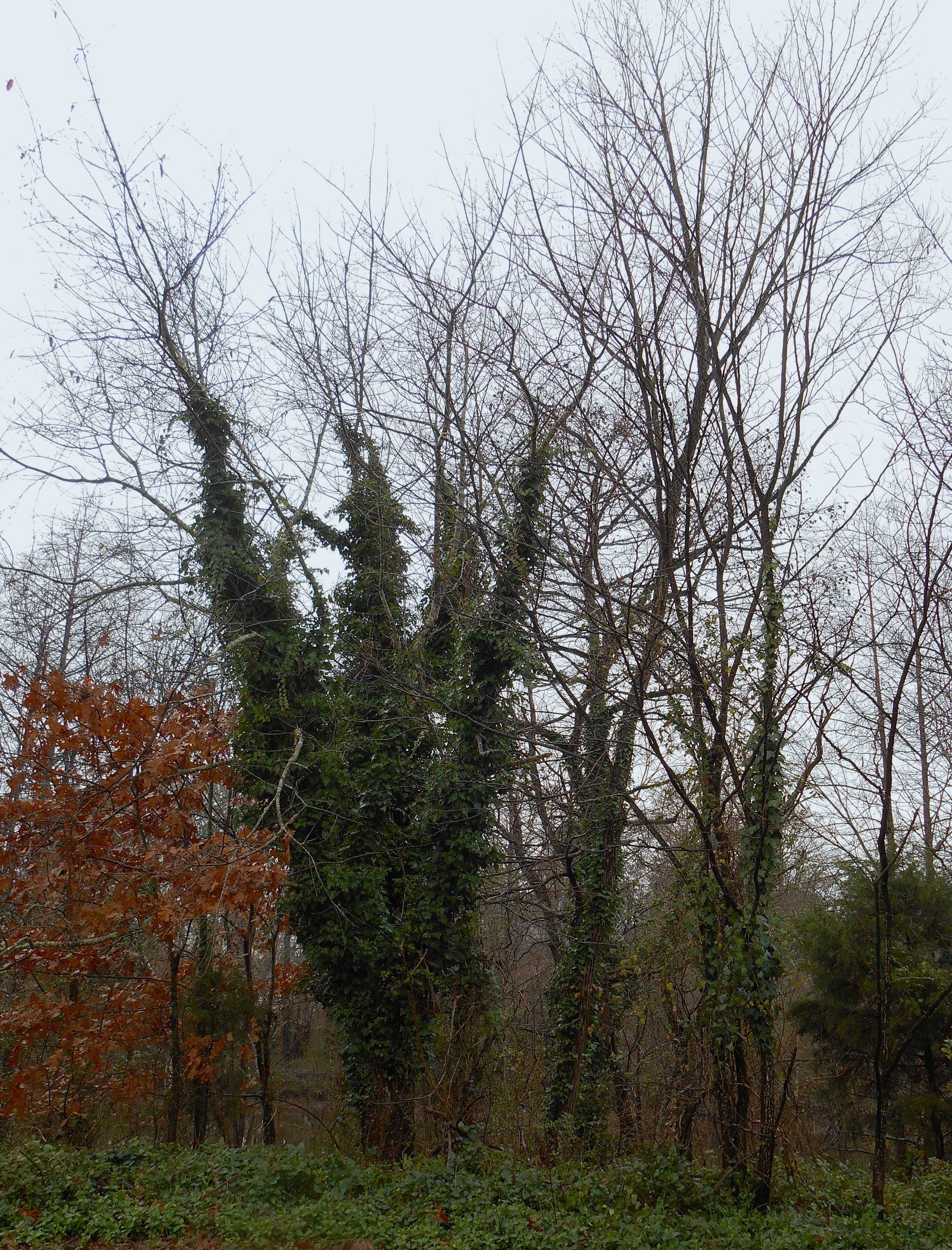
Ivy that escaped cultivation grows along a roadside in James City County, Virginia. It is more noticeable once the leaves fall for the winter. December 2013.
Plants are plants and had been living and functioning within ecosystems for many millennia before humans first thought to name, study, or categorize them. We like to sort and label things, and we have many categories for plants. In recent decades American gardeners have begun labeling some imported plants, those that can out compete many native North American plants, as invasive. But let’s set that label aside for a moment and simply consider how ivy contributes to the ecosystems wherever it grows.
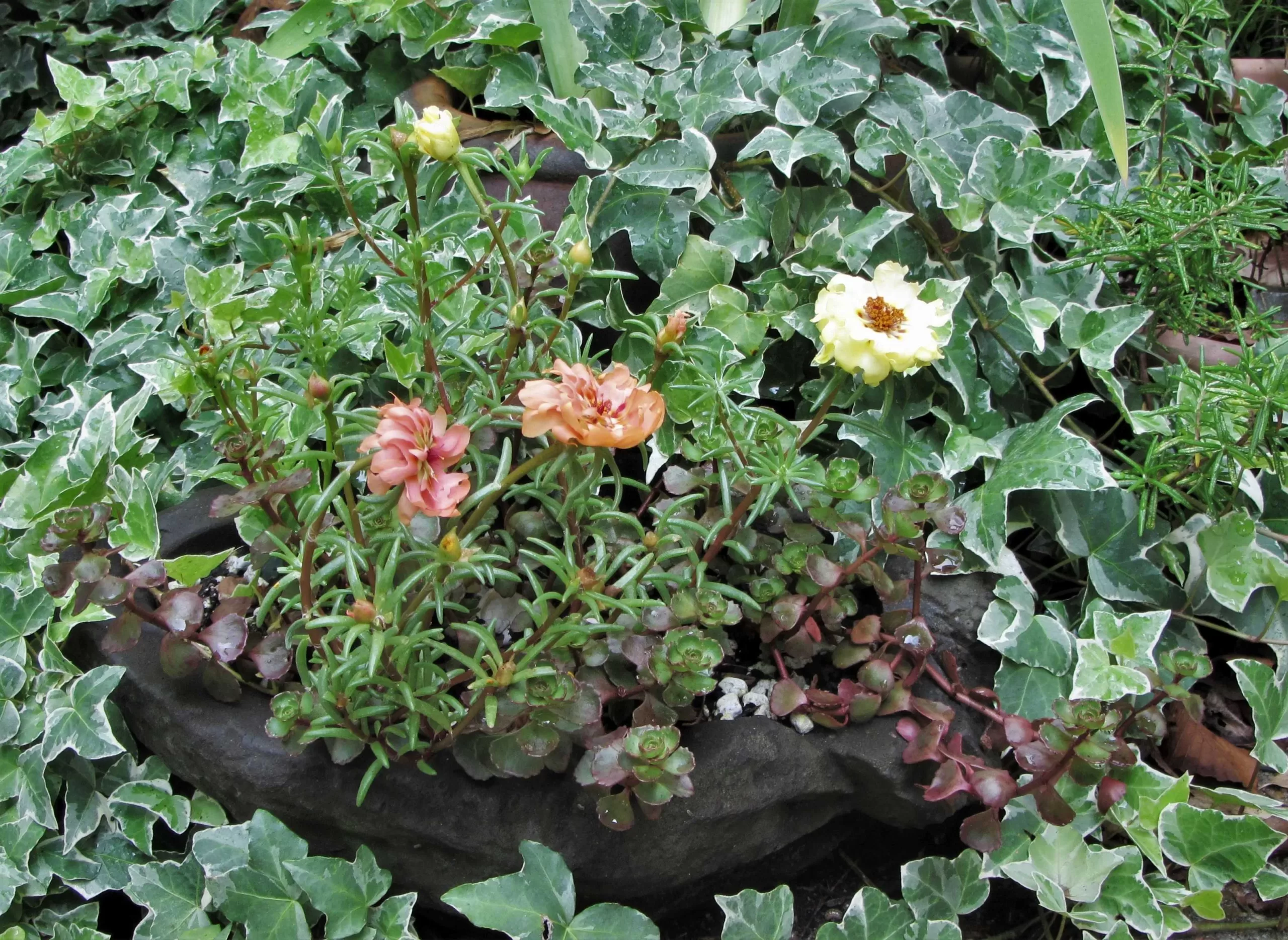
Variegated English Ivy covers the concrete around this container garden.
Ivy’s Ecological Services
Like all plants, ivy filters the air, removing carbon dioxide to use for photosynthesis. Like all other ‘light eaters,’ it performs complex chemistry to transform carbon dioxide into cellulose molecules which build the cell walls of its roots, stems, flowers, fruits, and leaves. Evergreen ivy absorbs and sequesters carbon dioxide and other gasses year-round.
While filtering out carbon dioxide, CO2, ivy is also filtering out other air pollutants including VOCs and tiny particulates of mold and fecal matter. It releases freshly synthesized breathable oxygen and water vapor into the surrounding air. A potted ivy plant cleans and refreshes interior air wherever it grows, removing harmful gasses emitted by stoves and fireplaces, household cleaners, carpets, paneling, and other building materials.
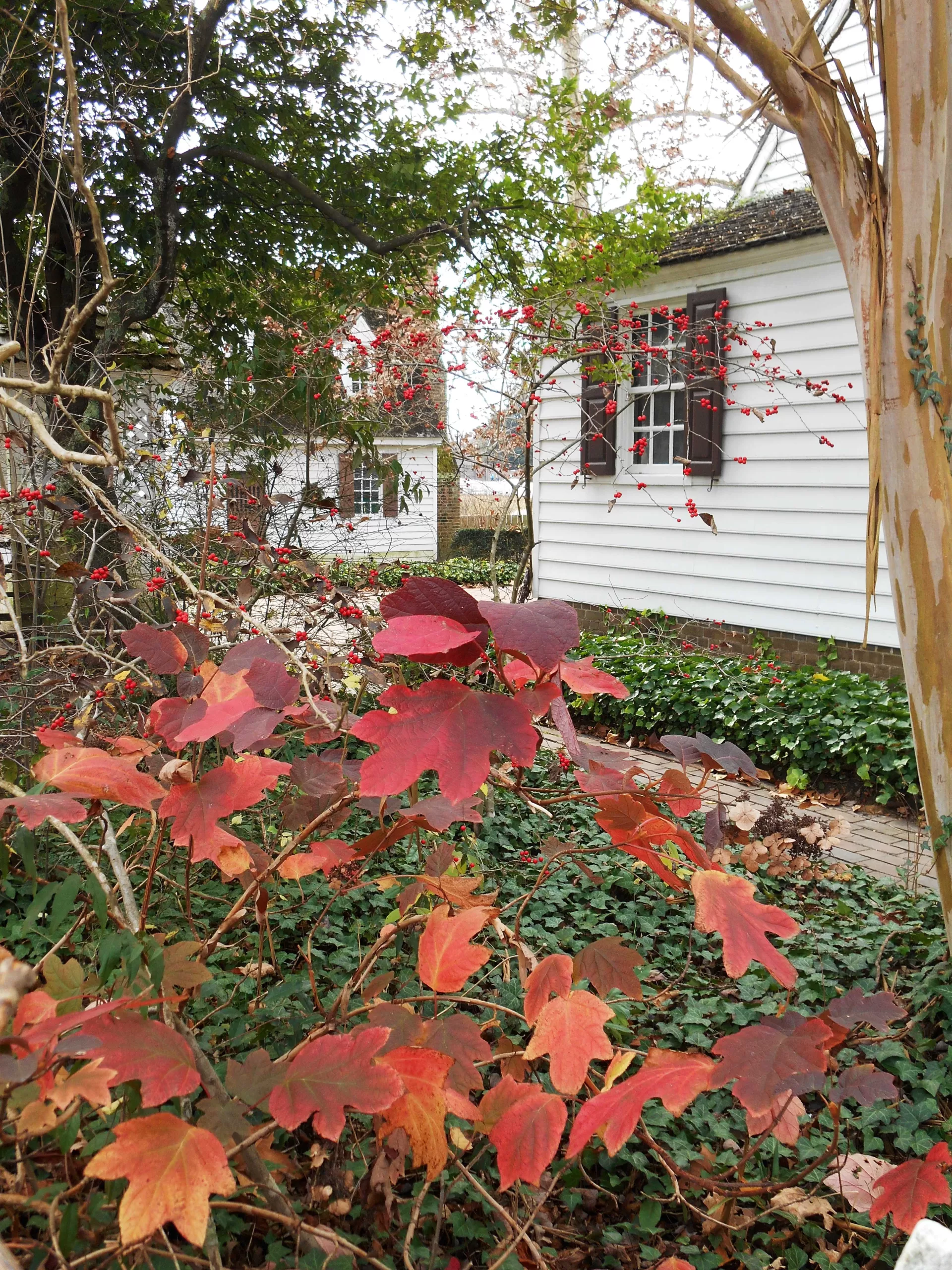
Evergreen ivy has been an important part of Winter Solstice, Yule, and later Christmas celebrations since ancient times. Early colonists imported ivy to Virginia from Europe to use as ground cover. Colonial Williamsburg, December 2015.
Ivy Absorbs Sunlight and Creates Shade
Ivy’s leaves absorb both light and heat. When grown on a wall or trellis, its leaves shade and protect, effectively lowering the inside temperature of any structure it cloaks. Ivy covers the exterior walls of many structures built before air conditioning to cool them through the summer and insulate them in winter. Ivy produces specialized roots which allow it to cling to brick, wooden siding, tree bark, and other porous surfaces as it grows. While these tiny adventitious roots help ivy to cling to surfaces as it climbs, the roots don’t penetrate deeply enough to damage brickwork that is in good repair. But it will protect brickwork from the effects of salt spray, acidic rain, and soot. And ivy shades walls to prevent the growth of moss, lichen, algae, or liverworts on the brickwork, according to information provided by Historic England. Ivy is a useful plant to grow on green walls and green roofs.
Ivy isn’t a parasite when it grows on another plant, like a tree, because it makes its own food through photosynthesis and doesn’t tap into other plants’ circulatory systems to steal food. Its tiny climbing roots can absorb water directly from dew, from fog, and from rain. Ivy growing on a fence increases privacy, cools the surrounding area, and provides wildlife habitat while covering an otherwise unsightly fence.
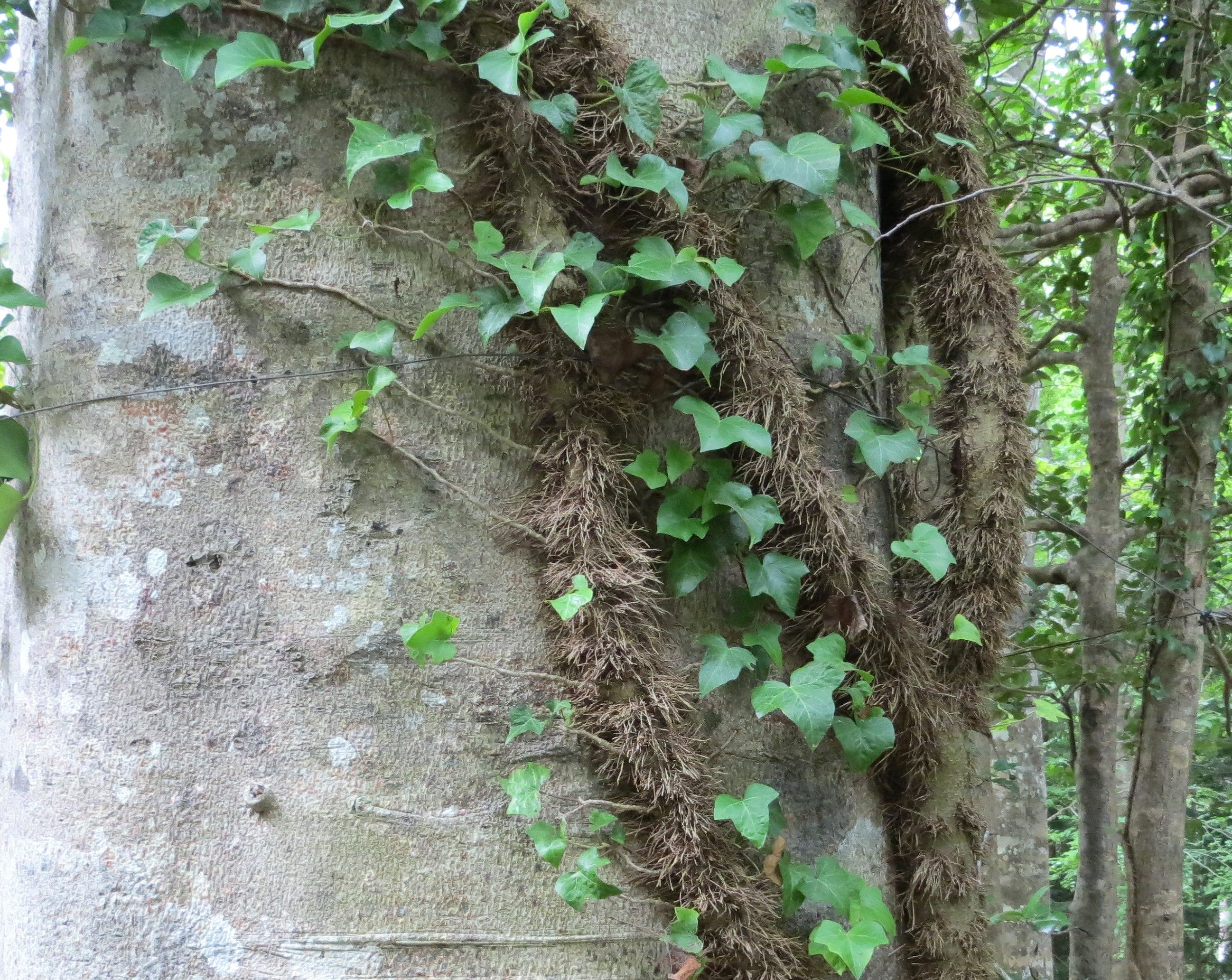
Ivy matures as it climbs, growing woody stems covered in tiny adventitious roots which collect dew and absorb moisture from the air. The roots don’t penetrate the bark to steal food or moisture from the tree, however. Ivy has grown on this beech tree for decades.
Ivy Changes Form as It Matures
Ivy matures and changes once it begins to climb. Its climbing stems become thick and shrub-like. They appear furry or hairy with aerial roots. The leaves subtly change shape, becoming more rounded and heart shaped. Cuttings taken from mature ivy can quickly grow into an upright, shrub-like form. Ivy grown as a shrub requires frequent pruning to keep the plant dense and compact.
Once ivy matures, it blooms with fat umbels, or clusters, of insignificant yellowish-green flowers in late summer, providing abundant late-season pollen and nectar for insects. The flowers transform into drupes or ‘berries’ by early winter which persist until spring. While poisonous for humans, these drupes help feed birds and other small animals through the winter. Birds then spread the seeds from these drupes in their droppings, which is how it escapes cultivation and can become invasive by sprouting in random places. Ivy becomes problematic when it escapes cultivation to colonize wooded areas, crowding out native plants.
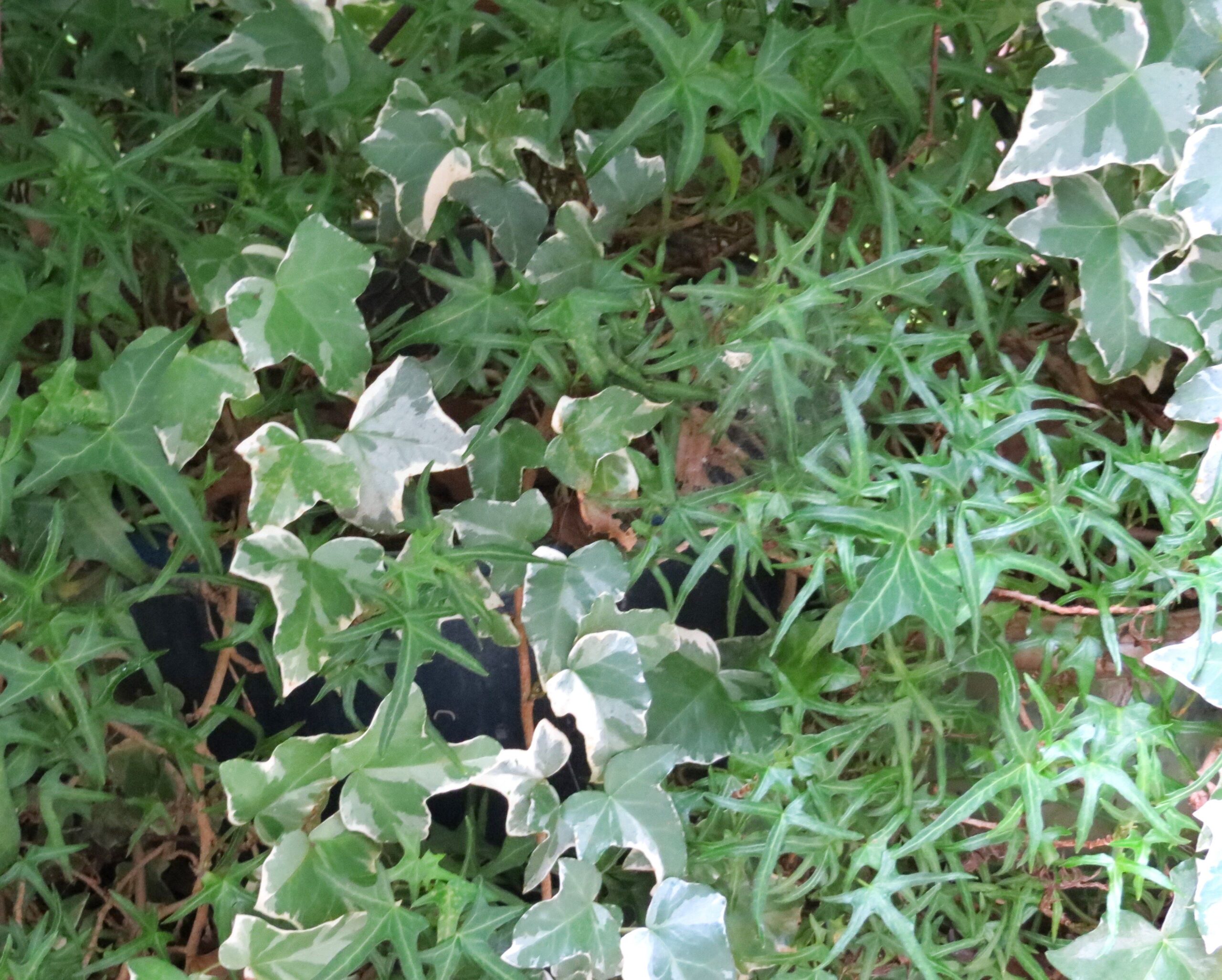
A variety of insects and other invertebrates, lizards, and even frogs may shelter in ivy’s dense cover and shade, providing a reliable food source for birds and small mammals. There are many cultivars of ivy with a wide range of leaf shapes and color patterns.
Ivy Supports Wildlife and Protects the Soil
Birds find cover and nest in ivy. Insects find protection and food under its dense leaves and along its stems. The vine provides habitat, safe spaces to reproduce, and shelter for a variety of animals both on the ground and on elevated surfaces where it grows. Although ivy leaves are mildly poisonous, some herbivores, like deer, goats, and cattle, will graze on them when other food is scarce. English ivy also serves as a host for various lepidoptera species in its native regions.
Ivy also stops erosion when it is grown as a ground-cover plant. It is a good choice for evergreen ‘lawns’ in shady urban areas where grass won’t grow well. It can be grown in narrow and oddly shaped spaces, between sidewalks and buildings, and on steeply sloping ground. Although ivy tolerates deep shade, it will grow in a wide variety of light conditions including full sun so long as the soil is fairly moist.
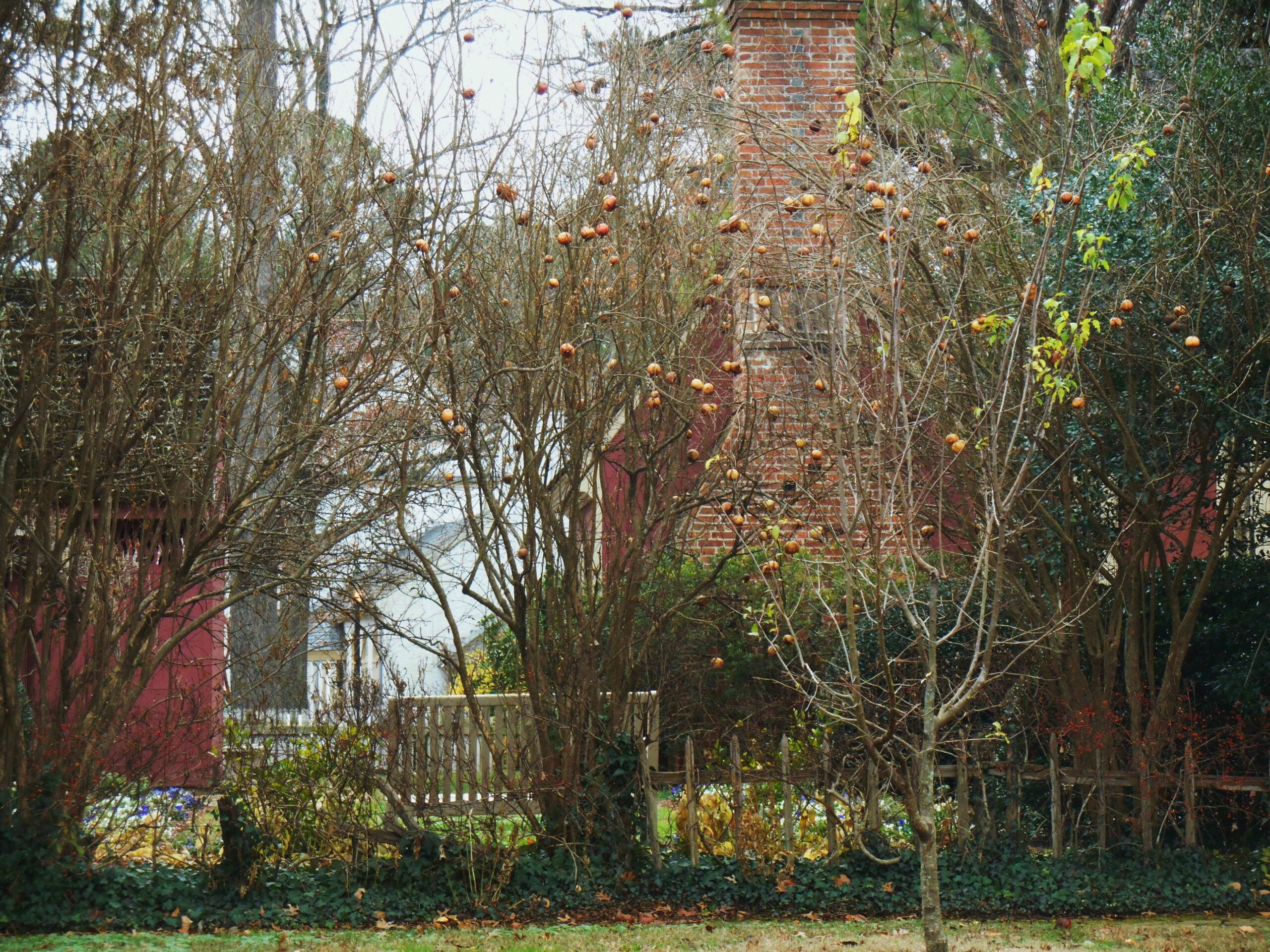
Colonial Williamsburg, early December 2014. Pomegranates ripen in the edge of a yard bordered in English ivy.
A Seventeenth Century Heritage
Ivy came to Virginia with the first English colonists and has now been cultivated in Virginia’s gardens for more than 400 years. Not only was it a beloved plant in English gardens, but it was used as a medicinal herb. Colonists brought a variety of useful and beautiful plants with them to make their settlements in the new world feel more like home. Visitors to Colonial Williamsburg and other sites throughout Virginia will find ivy growing in historic gardens alongside other imported plants like boxwoods, daffodils, cabbages, and various herbs.
But landscapers and residential gardeners have commonly planted ivy throughout Virginia and other states, since the colonial era, because it is adaptable, useful, attractive, and easy to grow. Most garden centers stock ivy plugs alongside plugs of Vinca minor, lily turf, and other ground cover plants.
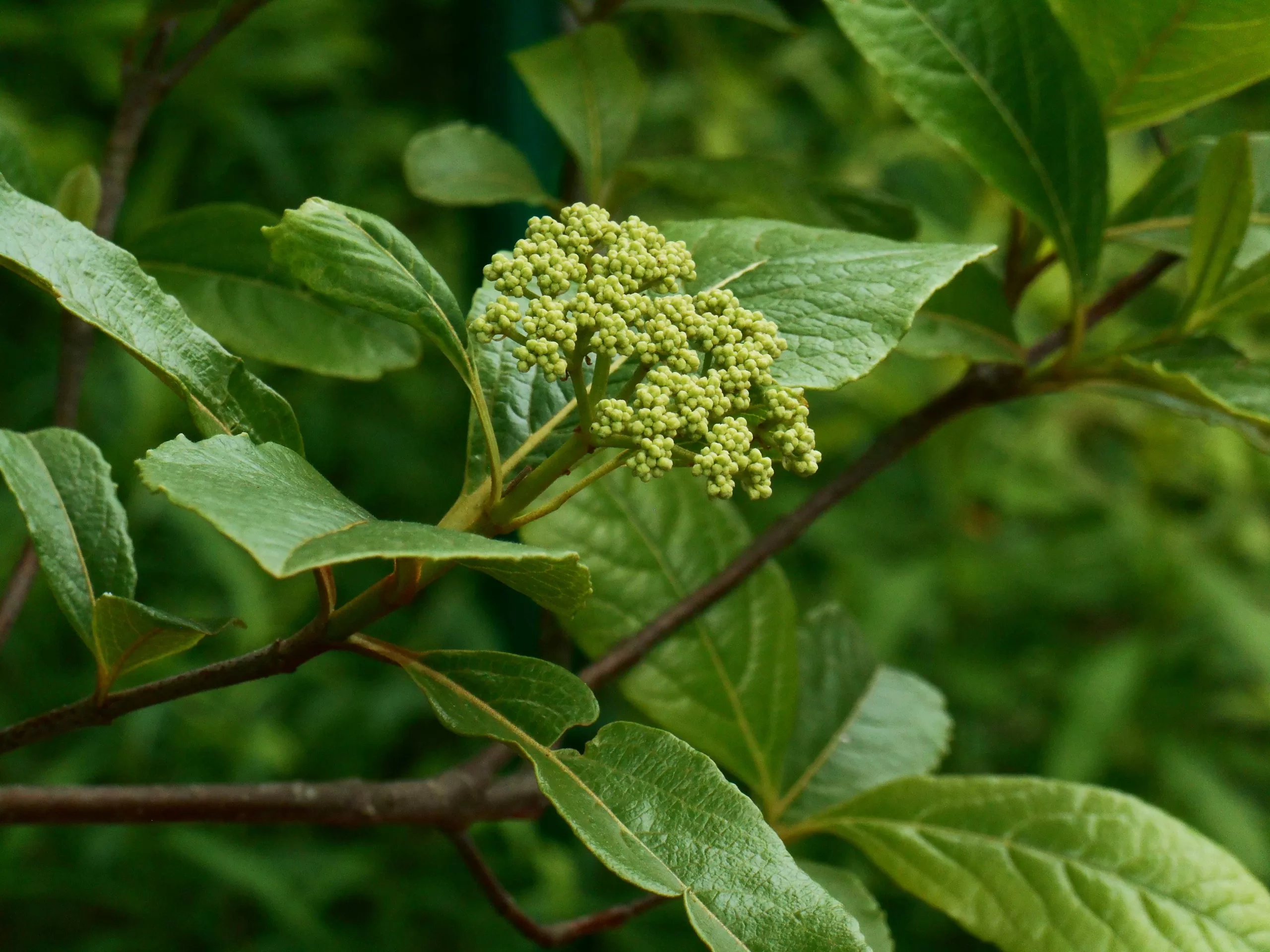
Climbing Hydrangea barbara prepares to bloom at the Williamsburg Botanical Garden and Freedom Park Arboretum in May 2018.
Native Alternatives to Ivy
There aren’t many North American native ground cover vines that can perform a similar function, but climbing Hydrangea, Hydrangea barbara, comes the closest. It is a semi-woody, deciduous vine native to the Southeastern United States hardy in Zones 6-8. It has glossy dark green leaves, climbs with adventitious aerial roots, and blooms with showy, white umbels of pretty flowers in the summer. It grows in the shade and needs consistently moist, acidic soil to thrive. This vine is very flammable, but it attracts pollinators and is somewhat resistant to deer grazing.
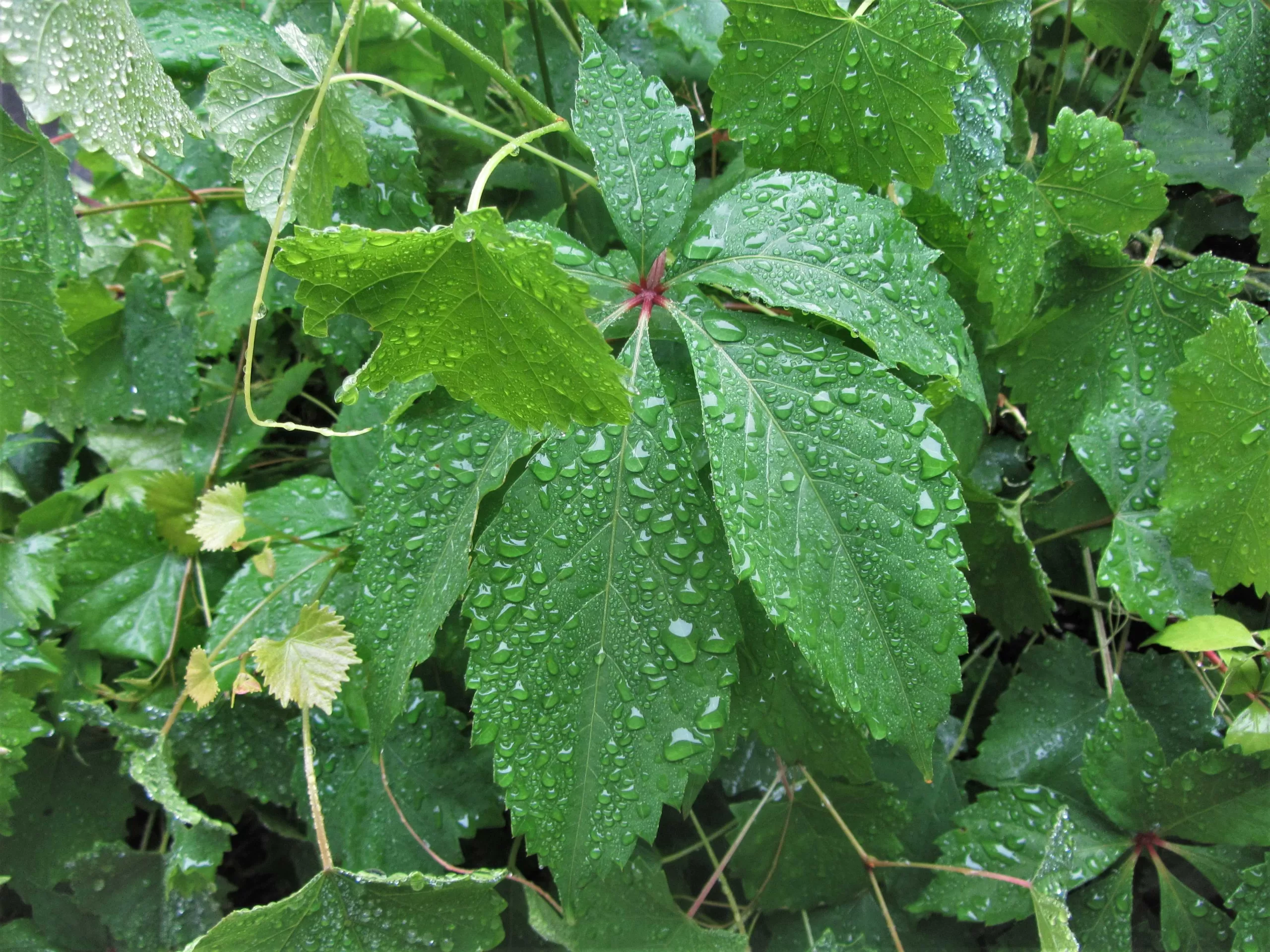
Virginia Creeper grows among native muscadine grapevines, Vitis rotundifolia.
While Virginia creeper, Parthenocissus quinquefolia, will climb walls and fences, it is deciduous and has much larger leaves. It is a woody vine in the grape family that can grow to 50′ tall but only about 10′ wide. It supports a variety of wildlife, producing abundant, but toxic berries in early winter. Virginia creeper, hardy in Zones 3-10, is also highly poisonous and highly flammable.
Wintergreen or teaberry, Gaultheria procumbens, also forms a dense, vining ground cover in deep shade in zones 3-7. It has tiny oval evergreen leaves, blooms earlier in the season and produces red berries in fall. This vine is more common in the Piedmont and mountains than in coastal areas. There are several native grape species, all deciduous, which may also serve as both ground cover and cloaking for fences and trellises. Grape vines also climb trees, however, with foliage even more dense than ivy’s foliage.
A variety of native and non-native vines colonize trees in coastal Virginia. The best way to remove vines from trees is to cut the vines at the base of the plant, just above its roots. The vine will soon shrivel and die. Trying to cut the vine out of a tree can be both dangerous and also damaging to the tree. It is very difficult to eradicate established vines without using chemical herbicides. Painting the cut of the rooted end of the vine with an herbicide can prevent it from resprouting form its roots.
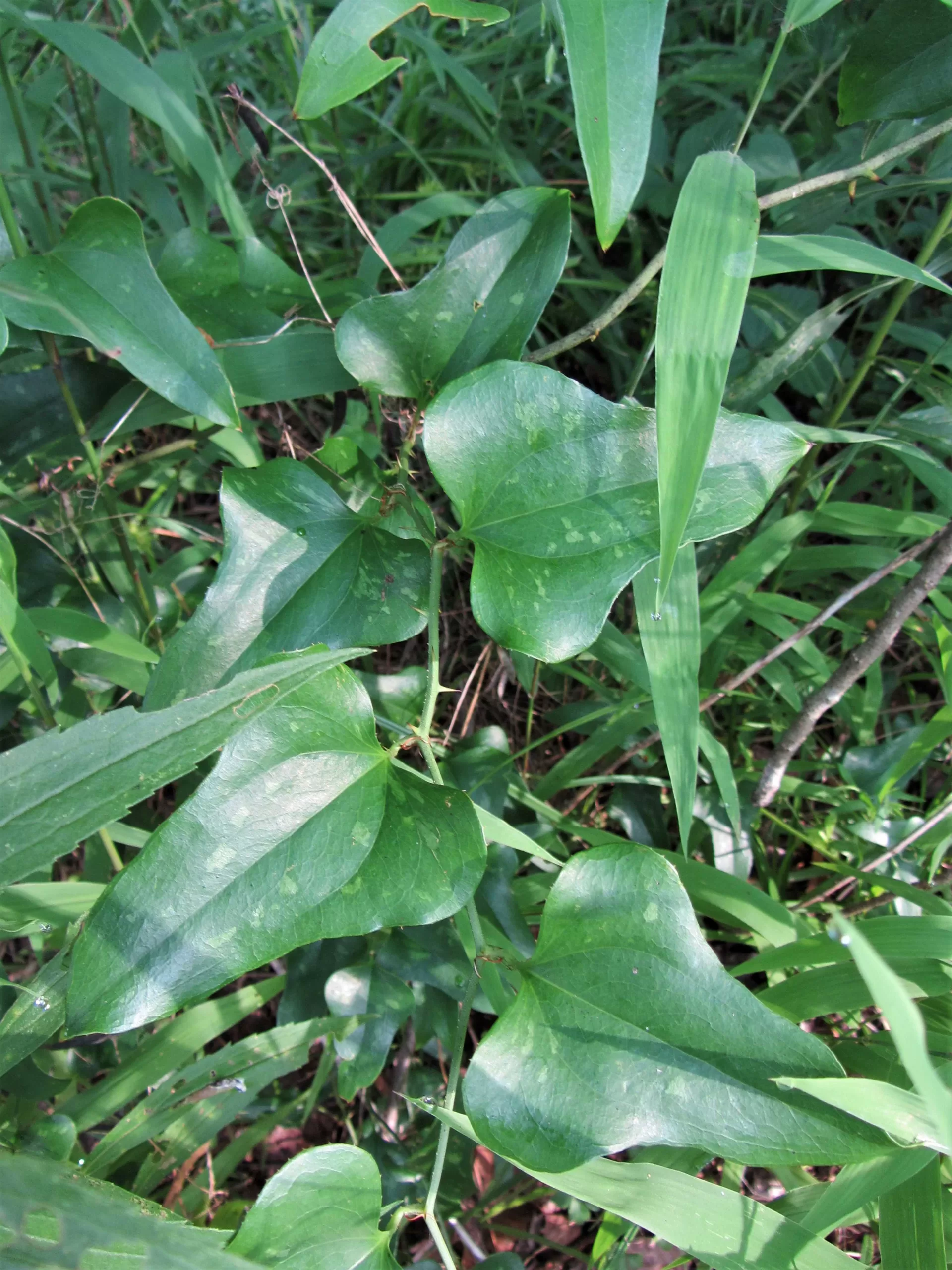
Smilax bona-nox, catbriar or greenbriar, grows wild in our area. It also climbs and colonizes local trees and shrubs, grabbing hold with its tendrils.
Native species of Smilax , or greenbriar, may be deciduous, semi-evergreen or evergreen and are adaptable to a variety of growing conditions. But their stems are covered in thorns, and they are generally considered weedy rather than ornamental. Smilax vines also scamper up trees and over shrubs and perennials as do Virginia creeper and ivy.
The Mythic History of Ivy
Ivy has a very long mythic history with strong cross-cultural associations. Ancient people considered it sacred and magical because it thrived and remained green through the winter, growing in even the most challenging places and circumstances. It seemed to them to be a symbol of immortality. Ivy has been associated over the centuries with a variety of both gods and goddesses including Osiris, Zeus, Pan, Dionysus, Bacchus, Attis, Cronos/Saturn, Rhea, Lakshmi, Persephone, Psyche, Isis, and Ceridwen.
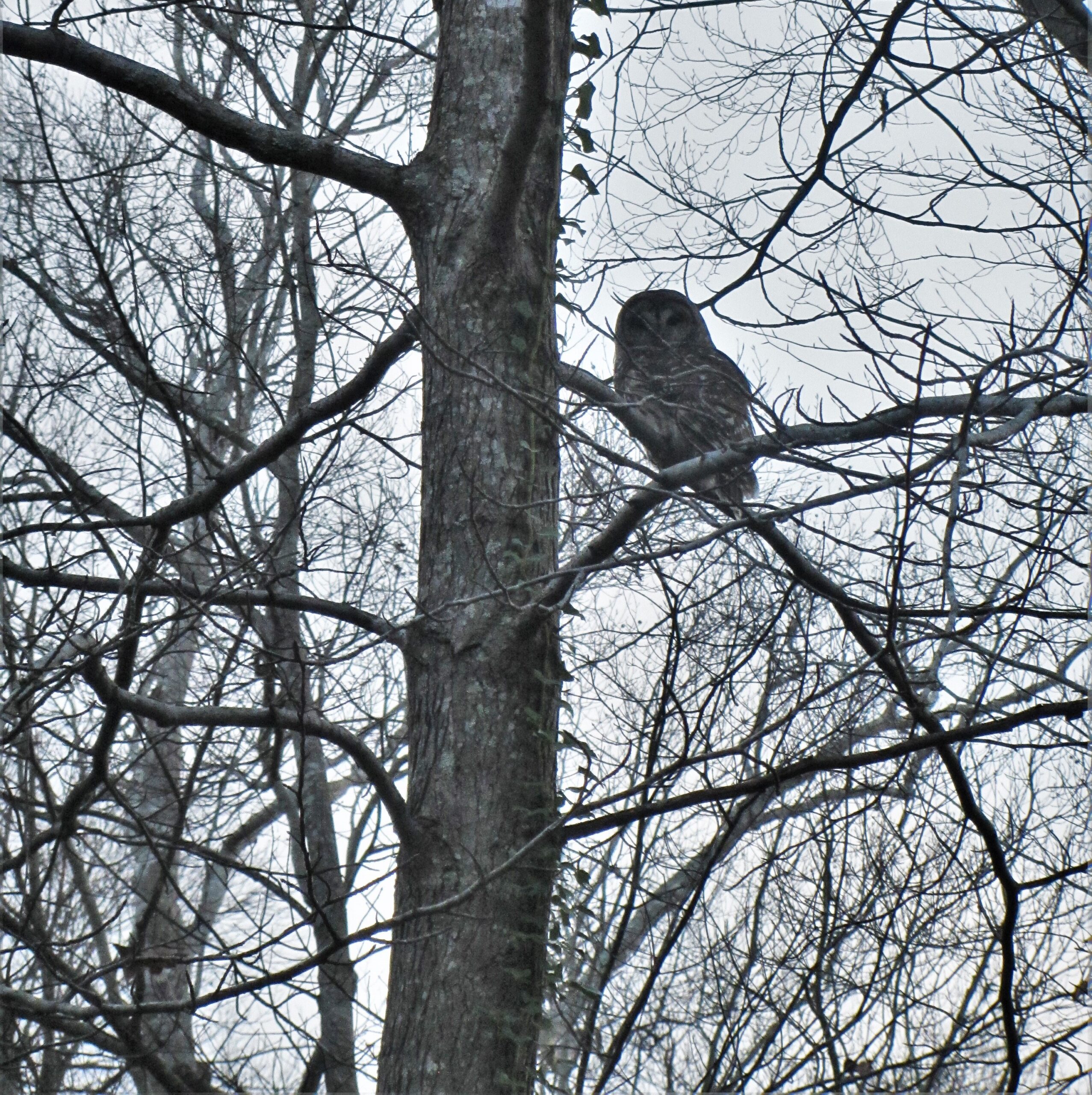
Ivy is associated with the undying sun, partly because it twines around things in a spiral, like the wheel of the year, as it climbs upwards towards the sun, and partly because it doesn’t go dormant in the winter. On a deeper level, ivy’s growth also symbolizes an individual’s journey cyclic through the passing years as they grow older, and perhaps wiser. It was an essential part of the Roman Saturnalia celebrations each December at the Winter Solstice, along with holly, an evergreen tree that produces red berries in winter which symbolize the returning sun.
Ivy has long been sacred to Druids and is one of the woody plants included in the Ogham, or tree alphabet, corresponding to the twelfth symbol, Gort, with a phonetic value of ‘G’. Ivy became an essential element of later Yule celebrations in the British Isles, where it is strongly associated with the Fae, or ‘the good people.’ The early Catholic church eventually accepted ivy as an element of Christmas celebrations, though they resisted it at first because of its associations with the old gods and goddesses.
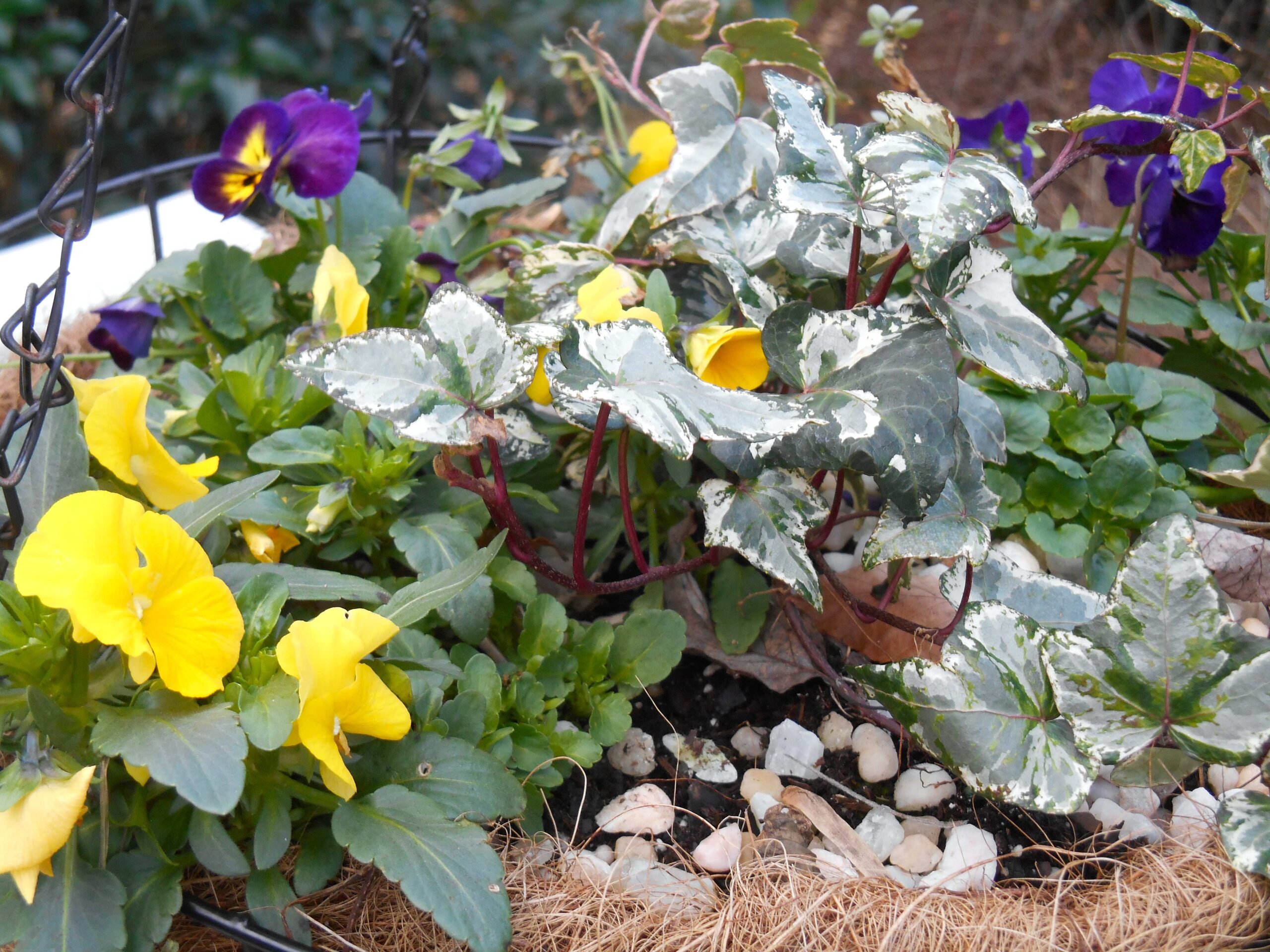
Ivy pairs well with Violas for colorful hanging baskets in winter.
Traditional Uses for Ivy
Ivy wood was used by the Greeks to make fire. In parts of England, ivy wood was made into special cups for children to drink from to protect them from whooping cough. Cups made of ivy wood were also popular for drinking wine in ancient times. In some traditions ivy leaves were considered hallucinogenic, and lore indicates they were steeped in wine along with other ingredients for ritual use. Other traditions hold that ivy can protect one from intoxication.
The Greeks wove the flexible stems of ivy into wreathes presented to the victors in athletic and other contests, to victors in battle, and to newly married couples. Ivy is still included in bridal bouquets as a symbol of faithfulness in marriage. Dionysus and other gods and goddesses were depicted wearing crowns of ivy. Ivy symbolized eternal love, and in the Victorian language of flowers meant, “I choose thee above all.” One of its properties is to bind people, and to bind groups together in cooperation and harmony. Ivy leaves were used in a variety of love charms and spells, for divination, to prevent drunkenness, and for other forms of protection.
Medicinal Uses for Ivy
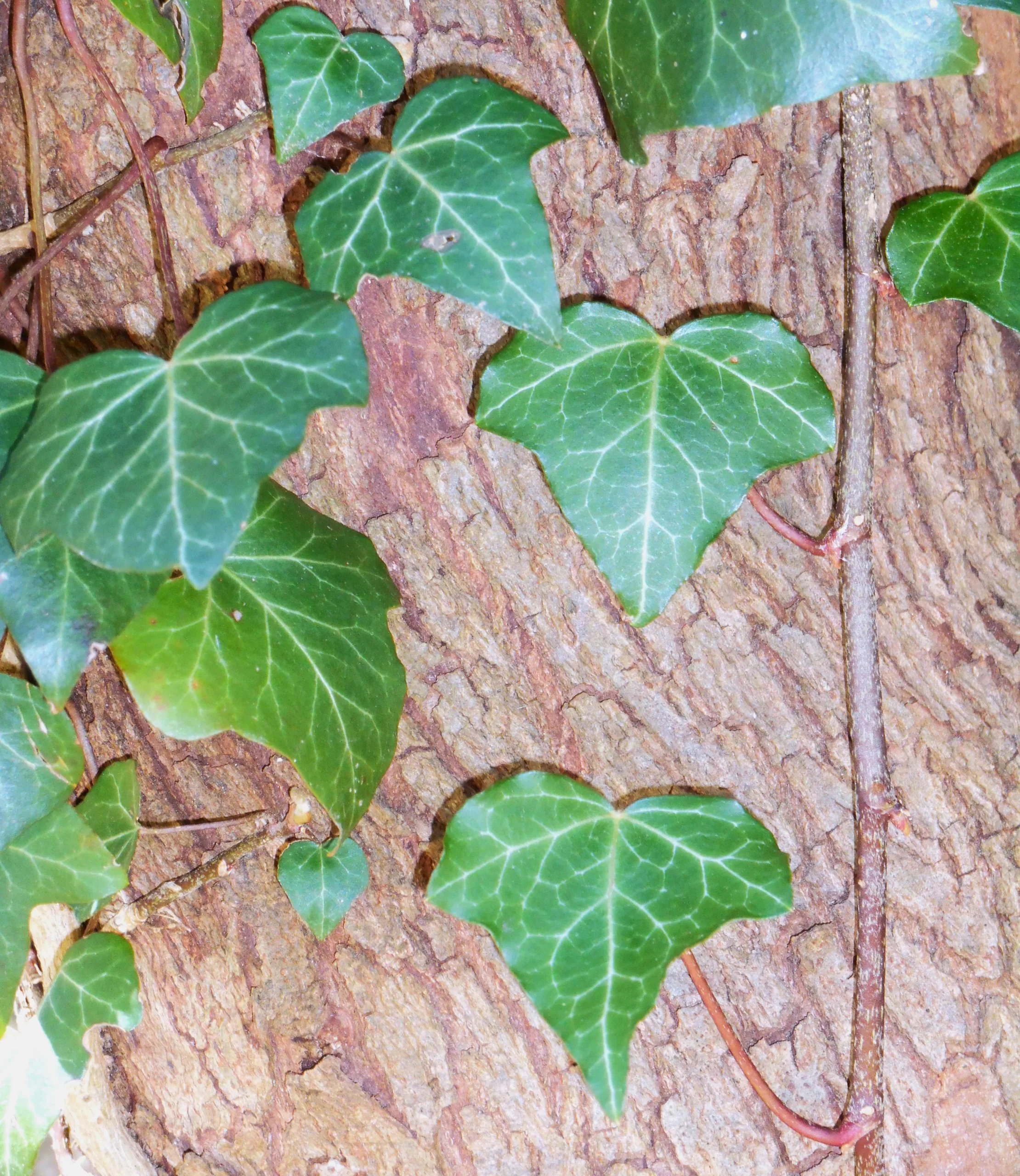
Ivy leaves used as a poultice can draw infection out of a wound. The leaves are both antifungal and antimicrobial. An infusion or lotion made from ivy leaves can ease tired muscles and relieve pain. Ivy is only recommended for topical use today, although it was used in a variety of medicinal folk remedies in the past. Ivy should not be eaten or taken internally because all parts are considered poisonous if ingested, and the sap may cause contact dermatitis for some sensitive individuals. An infusion of ivy leaves can be used, however, to clean areas in the home where mold is a problem, as the phytochemicals in ivy help to kill mold.
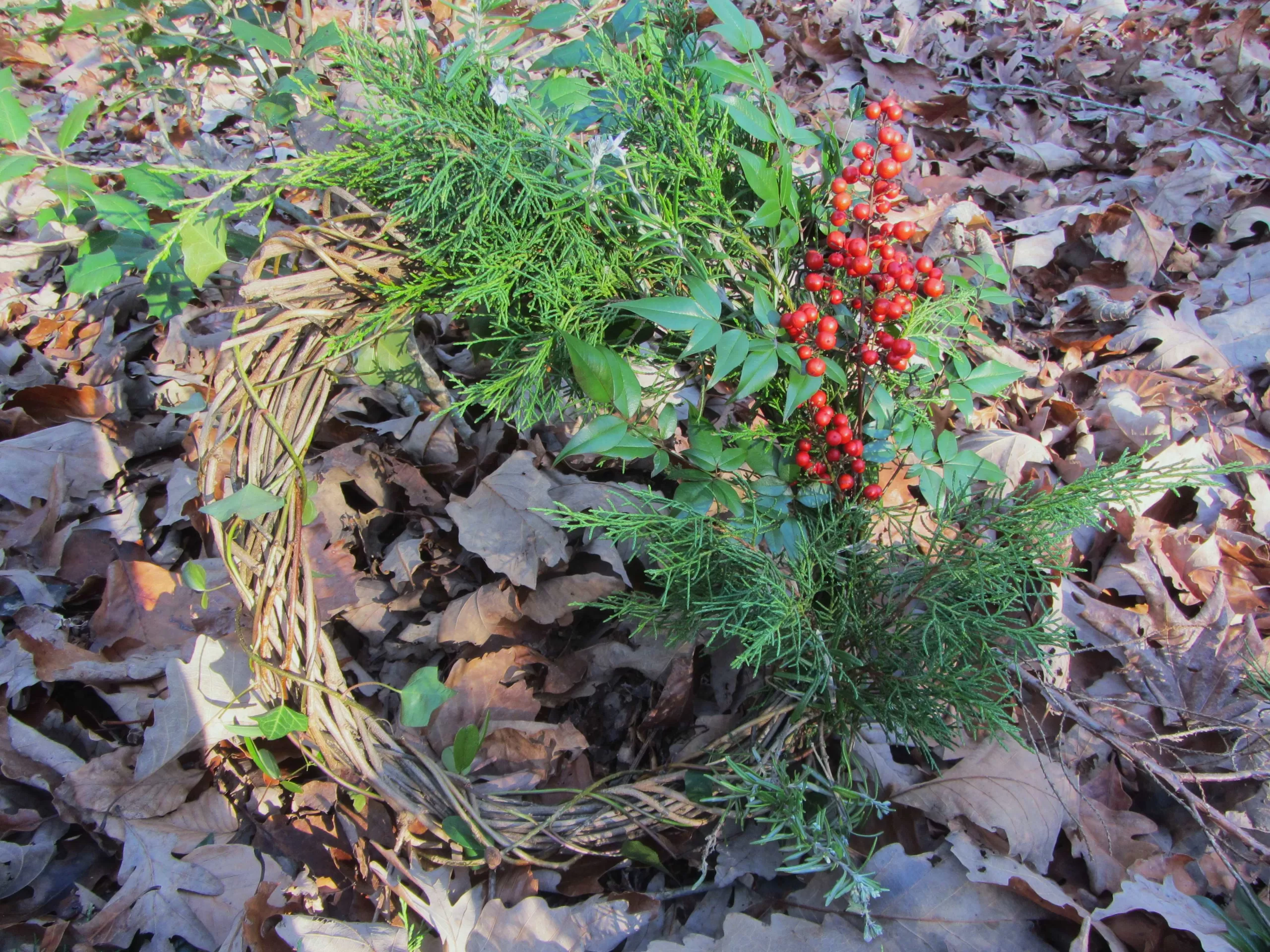
Fresh ivy and other evergreen plants decorate a grapevine wreath for Yule. Red berries represent the return of the sun after Winter Solstice.
Ivy Remains a Part of Our Culture
English ivy is still used today in wreathes and other decorations at Christmas to remind us of eternal life, hope for the future, and the cyclic nature of life. Ivy vines may be grown in winter container arrangements along with evergreen shrubs, ornamental cabbages, winter annuals, and spring flowering bulbs. So long as the ivy remains in its juvenile form, and doesn’t bloom or form drupes, it can’t escape cultivation. Ivy is still considered a joyful, celebratory, and ‘protective’ plant by those who follow the old ways. It is traditionally grown near the doors to one’s home to keep evil away from the household.
How can a useful plant, one that is considered sacred in many cultures, fall to the level of a ‘noxious weed’ in another culture over the course of only a few decades? That question is worth a bit of thought. I wonder, sometimes, if in our fervor to safeguard our North American native plants we dismiss the strengths, usefulness, and cultural history of plants native in other lands. Let us remember that our ancestors made the effort to bring these plants to their new home in North America, and to nurture them, because they considered them important and useful plants. Since ivy isn’t a parasite, and its growth can be controlled with a bit of planning and effort, let us not be too quick to dismiss it. It still proves itself a beautiful, useful and a culturally significant plant in contemporary homes and gardens when it is cultivated responsibly.
All photos by E. L. McCoy