The Origin, Locations, and Date of Planting of Colonial Williamsburg’s Compton Oak
The Origin, Locations, and Date of Planting of Colonial Williamsburg’s Compton Oak

Street view of the Compton oak in 1979; photo courtesy of the Colonial Williamsburg Foundation’s archives.
This superb specimen of Compton oak (Quercus xcomptoniae) is located in Market Square, within the boundary of historic Colonial Williamsburg, Virginia, USA.
For the benefit of non-US residents, Williamsburg was founded in 1632 by English settlers. It became the capital of the Colony and Commonwealth of Virginia in 1699 and remained so until 1780. Tensions between the Colony and the British Crown and Government developed, fuelled particularly by British attempts to impose taxation without representation in Parliament. This led to calls for independence and to the mustering of a revolutionary army in Williamsburg. Soon, all 13 of the original English Colonies supported this call, and the American Revolutionary War was declared in 1775. Thus, the city was instrumental in the birth of the United States of America.
Modern-day Colonial Williamsburg, which is dedicated to telling that story, is in part a restoration and in part a reimagining of the historic core of the former capital. It is a very significant tourist attraction. I am one of the Arboretum volunteers and a Tree Steward.
In the summer of 2023, at the suggestion of garden historian Wesley Green, I began an investigation to see if the Archives at the Rockefeller Library could provide any information about the original location and date of planting of the Compton oak in its present location.
The Library houses some of the correspondence of the Colonial Williamsburg Foundation’s former Landscape Superintendent, Justin B. Brouwers, and it provides an invaluable first-hand account of how and when the Compton oak came to be located in Colonial Williamsburg’s Historic Area. According to that correspondence, Brouwers discovered it in the wild in an area known as “Boush Creek, South of Norfolk, Virginia in 1937.” He wrote to the U.S Department of Agriculture in 1947, seeking help to identify the oak. He stated, "This tree was growing about twenty-five feet from the edge near brackish water. It was dug and transplanted to Williamsburg in 1938. At the time of moving it was about 15’-18’ tall and had a trunk diameter from three to four inches at the ground. This tree grew no nearer than approximately one-half mile from Live Oak trees. Since transplanting the tree in Williamsburg, it has grown between thirty-five and forty feet, and its trunk diameter is now from 10 to 12 inches at the ground.”
Brouwers initially thought the tree was possibly a live oak, Quercus virginia, or perhaps some sort of unidentified hybrid. But, after a few years, he apparently became curious when it did not behave like other live oaks in the area and enlisted the assistance of Dr. J.T. Baldwin, a prominent botanist and head of the Biology Department at the College of William and Mary, to obtain a more positive identification. The tree was referred to simply as “Brouwers’s Oak” during this period.
Dr. Baldwin wrote to Ernest J. Palmer, the collector-botanist at Harvard University’s Arnold Arboretum in January 1947, and sent samples to assist with the identification. Palmer was a noted botanical taxonomist specializing in the Quercus genus.
Palmer responded promptly, saying that Baldwin’s “surmise as to it being a hybrid between the live oak and a deciduous species is certainly correct. I think there can be no doubt that the other parent is the overcup oak (Quercus lyrata Walt.).” It was fortunate that Baldwin involved Palmer since the Compton oak was discovered and first named in 1918 by his mentor, Charles Sprague Sargent, the first Director of the Arnold Arboretum. Sargent made the discovery after a trip he made to the property of Miss C.C. Compton near Natchez, Mississippi. In his response Palmer described the origin of the Compton oak at length and verified that the oak planted by Mr. Brouwers was, in fact, the same hybrid, Q. xcomptonae (sic).
In the meantime, S.F. Blake, Senior Botanist at the United States Department of Agriculture, responded to Brouwers that “[n]ot being able to match your oak specimen here I sent it to Dr. Rehder at the Arnold Arboretum. He identifies it as a Quercus comptonae (sic) Sarg. Thus, Dr. Baldwin and Mr. Brouwers initially corresponded independently with different experts at different locations and received the same conclusion from two different authorities, both employed at the Arnold Arboretum.
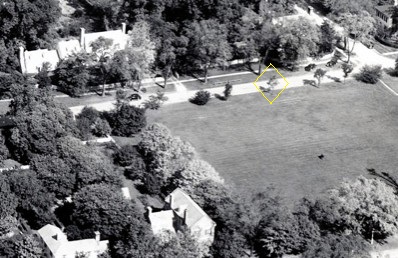
The young Compton oak in 1940, widely spaced from its neighbors, fortunately
The final question raised by Wesley Green concerned how the Compton oak came to be the lone hybrid of its species growing at Boush Creek. Responding to a request from Baldwin, Brouwers provided further details to Palmer in a letter of February 1947. Brouwers explained that: “There was another tree similar to this growing not far away from this tree – near the shores of Bousch (sic) Creek – its leaves were larger, broader, and not quite so persistent. The nearest Live Oak to these two trees was about one-half mile away. During the war this area was taken over by the Government; hence all trees in this location were destroyed.”
I checked historic maps that refer to an area in Norfolk once called Boush Creek. I found that Bosch Creek was located at the northern edge of Norfolk City on Willoughby Bay. There is nothing in that area with that designation on modern maps.
When last measured in 2024 the tree was 66 feet high with a trunk girth of 18 feet 2 inches and an average crown spread of 130 feet. The size of the tree causes visitors to estimate the age as far greater than its actual 100+ years. It tends to favor the growth habit of its Q. virginiana parent but its measured growth over its lifetime indicates that its size increases at a far faster rate than its live oak neighbors located in the Historic Area that were planted during the same decade. It is reported to be the largest example of its species in the United States. Prior to 2025 it was recognized as the State Champion “Big Tree” for being the largest of its species on the Virginia Register of Big Trees. However, hybrids are no longer considered for nomination for championship status.
The size, backstory, and hybrid parentage of this remarkable tree all contribute to make it a natural attraction in this historic setting. The appeal of the Compton oak comes in part from its unique character as a naturally occurring hybrid. It is located in an open area where it is very visible to the several hundred thousand annual visitors to the site. It is the largest and most prominent tree located in Colonial Williamsburg. Over the years visitors return to have their photographs taken under it to mark special occasions. Guided Arboretum tours begin at the Compton oak and visitors are keen to hear how one of this species came to be located here. The professional arborists at Colonial Williamsburg well tend it, and recently barriers have been placed around the drip line to restrict direct access to lessen the impact of root compaction caused by visitors.
Thanks to garden historian Wesley Greene for the initial review of the Archive’s photographic records, for providing the background information to this study. Thanks also for the invaluable assistance of Donna Cooke, Archivist, and Marianne Martin, Visual Resources Collection Librarian, at the Colonial Williamsburg’s Rockefeller Library, without whose help these materials would surely not have been found.