Category: Carbon Garden

Cultivating a Tiny Forest (Part 1)

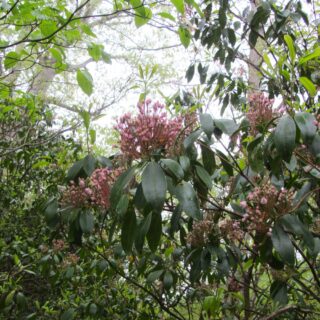
  Our once shady front yard was left a bright expanse of coarse wood chips and mangled leaves after the arborists pulled out their heavy equipment and left, that hot summer afternoon almost a dozen years ago.  A freak summer thunderstorm had harbored a waterspout or small tornado when it blew in from College Creek a few days before.  Our first clue that something was wrong had been seeing the underside of a muddy root ball rising 8 feet or...
Part 2: PNV: Potential Natural (Native) Vegetation

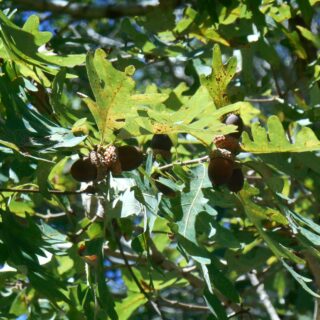
  Appropriate Species for Tiny Forests in Eastern Virginia Tiny forests designed following the Miyawaki method include a wide variety of native trees, shrubs, and ground covers planted randomly and densely, varying the heights of trees to establish a canopy layer, intermediate layers, and a ground cover layer.  Plant as many as 3 to 5 plants per square meter into the prepared soil.  Plants grow quickly, reaching for the light.  A forest that takes a century or more to develop...

Mythical Rosemary

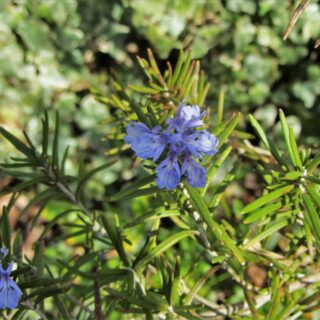
  Mythical Rosemary The woody, green fragrance of rosemary brings happiness.  Rosemary has served as food, fragrance, medicine, as a religious tool, and as a favorite garden plant for millennia. It is considered a sacred and magical herb, associated both with Aphrodite and with Mother Mary.  Rosemary has been planted in monastery, temple, medicinal and royal gardens over many centuries. Known now as Salvia rosmarinus, rather than the Rosmarinus officinalis we all learned, rosemary has one of the longest cultural...

Peonies for Mothers’ Day

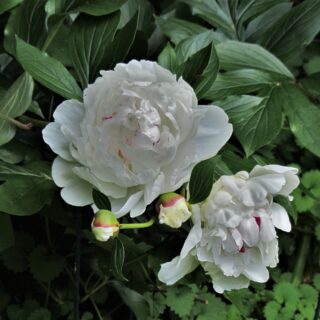
Peonies Symbolize Femininity, Wealth and Honor The peonies always bloom for Mothers’ Day in Eastern Virginia, alongside the roses.  Roses and peonies are just part of the romance and beauty of mid-May in our area.  Their full, heavy blossoms packed with petals invite the gardener to snip a stem or two for the vase inside, especially when there is rain in the forecast.  Peonies invite us to pause and gather May’s flowers in the moment, savoring one of the most...

Early Summer: To Do, To Do Less, and To Avoid

What To Do in May and June Avid gardeners find lots to do during May and June as spring melts into summer.  The enjoyment of spending time outside watching things grow and listening to the birds can distract us from our spring to-do list.  But taking care of business early in the season will result in a more attractive garden and more success through the summer months ahead. The days are getting noticeably longer and warmer as the first flush...

Hedges and Hedgerows Part 2: Making Good Choices

  Planting Reliable Shrubs in Tough Conditions Home builders and contract landscapers rely on tried-and-true shrubs that they expect to out-live their warranty.  That doesn’t mean that they are planting the most beautiful shrubs in new neighborhoods, or even the most appropriate ones for the site. They certainly don’t try to replace the sorts of native shrubs that might have grown on the site before it was razed for construction.  But they choose reliable shrubs that they expect prospective buyers...

 Hedges and Hedgerows for a Healthier and More Peaceful Life, Part 1

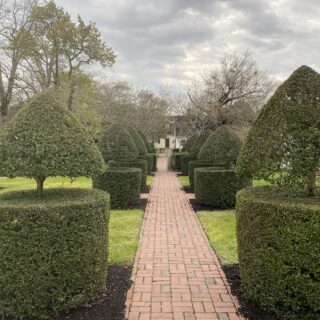
  The Living Fence Gardening is the art of domesticating the wild, of creating living geometry within our landscapes.  Order, symmetry, lines, and boundaries please the eye and soothe the spirit.  We are inclined to organize and define our spaces by dividing them up into smaller pieces we can manage, to protect them within walls and behind gates.  We contain what is ours, setting aside sacred space, our own ‘paradise,’ from the wider world.  We exclude the unwanted wildness living...

Yaupon, A Native American Tea

“What’s in a name? That which we call a rose, By any other word would smell as sweet.” William Shakespeare, Romeo and Juliet v. Q2 1599     What is in a name?  How does naming a thing affect its destiny and how later generations will view it?  The story of how a popular native holly came by its name, and how that name destroyed a promising Colonial American industry, demonstrates that names have incredible power to shape the future....

A History of Our War With Plants

  “I use only native plants, native to the planet Earth.  I am using indigenous plants; they are indigenous to this part of the universe.” Bill Mollison, Founder and Director of The Permaculture Institute     In the Beginning… Let’s begin with the obvious:  we live within an ever-changing ecosystem.  Europeans came to North America more than four centuries ago, cutting trees, planting fields, building homes and roads.  Native Americans also cut trees, built homes, planted fields, hunted, and lived...

Why Bother With Bulbs?

  Bins of papery brown bulbs appear in every garden center and big box store right after the back-to-school displays disappear for another autumn.  I love to study the photos of bright spring flowers on the bins, bags, and boxes of bulbs. They invite the ultimate impulse purchase.  “Where to plant them?” you may wonder.  No matter, you’ll find a spot. As trees turn gold and scarlet, we feel the chill in the air, and know that the long summer...